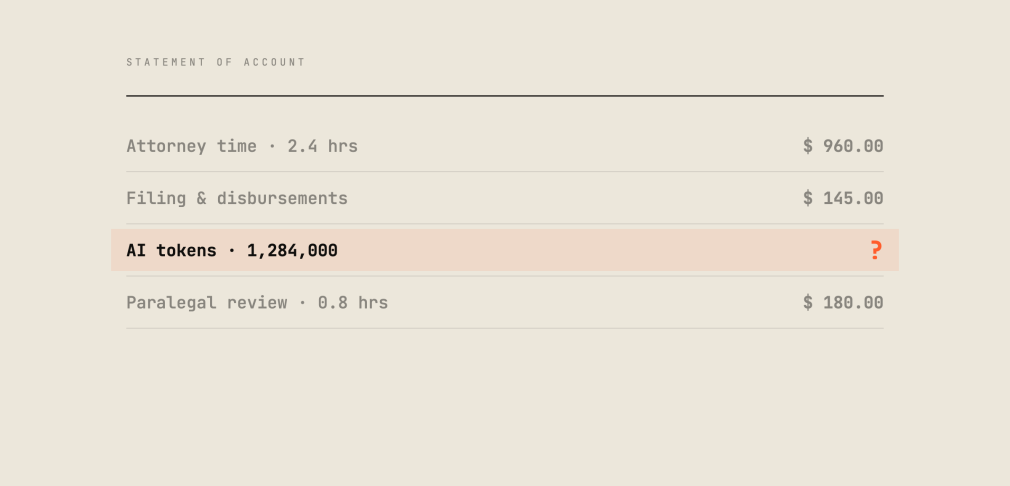
AI has quietly become a line item in the practice of law. Every contract a lawyer drafts with an AI assistant, every diligence review run through a document analysis tool, every research query answered by a legal AI platform consumes compute. That compute costs money, whether it shows up as a metered API bill, a per-seat subscription, or an enterprise contract. So the question clients are starting to ask, and the question lawyers should be answering before they are asked, is simple: who pays for the token?
Right now, the honest answer is that it depends on the firm, and most clients have no idea which arrangement they are in.
The three models operating today
Model one: the firm absorbs it. Most firms today treat AI spend the way they treat Westlaw, practice management software, or the office printer: overhead. It is baked into the hourly rate, just like rent. The client never sees it. This is the path of least friction, and for subscription-based tools it is often the only ethically clean path, because a lawyer generally cannot mark up or pass through a fixed cost the firm would incur anyway. Oregon’s 2025 guidance made this explicit for flat-fee subscription tools and directed lawyers to inform clients, preferably in writing, before charging for AI costs.
Model two: the firm passes it through. Some firms treat metered AI usage like a research database charge or a court filing fee: a disbursement invoiced to the client at cost, disclosed in the engagement letter. This works, narrowly, for genuinely per-use costs, such as a per-query or per-document charge tied to a specific matter. It does not work for flat subscriptions, and it will never be a revenue line. Cost recovery recovers cost. Nothing more.
Model three: the firm prices it into the fee. The most forward-looking firms stop asking who pays for the token and instead reprice the work itself. If AI cuts a four-hour drafting task to forty minutes, the firm charges a flat fee calibrated to the value of the output, captures the efficiency as margin, and the token cost disappears into the economics the same way electricity does. Virginia’s Legal Ethics Opinion 1901 blessed this approach, confirming that a lawyer may charge the same flat fee for AI-assisted work as for manual work, provided the fee remains reasonable.
The ethics layer nobody can route around
Whatever model a firm chooses, the ethics rules set the floor, and in the United States that floor is now well defined.
The ABA’s Formal Opinion 512 established the baseline: lawyers billing hourly must bill actual time spent, even when AI compresses the work. If the machine runs three hours, the invoice says twenty minutes. The opinion also warned that a flat fee can become unreasonable if AI has drastically reduced the effort behind it, and that boilerplate engagement letter language will not satisfy the informed consent requirement for AI use. Texas Opinion 705 added a transparency obligation when AI reduces the time required for a task. Florida’s Opinion 24-1 pushed firms to obtain consent before feeding confidential information to third-party generative AI at all.
Read together, the rules point in one direction. A lawyer cannot silently pocket the difference between what the work used to cost and what it costs now while billing as if nothing changed. The efficiency has to go somewhere visible: into a lower hourly total, a disclosed pass-through, or a flat fee the client agreed to with eyes open.
The tension that forces the change
Here is where the current arrangement becomes unstable. Efficiency gains from AI are real and large. Lawyers using generative AI report saving up to 260 hours a year, roughly 32 working days. Yet a joint survey by the Association of Corporate Counsel and Everlaw found that nearly 60 percent of in-house counsel have seen no noticeable savings from their outside counsel’s use of AI, and a majority of those blame firms for not adjusting their pricing. At the same time, 61 percent of in-house teams plan to push for pricing changes tied to AI.
That gap cannot hold. Clients know the tools exist. They are increasingly using the same tools themselves. Procurement teams are writing AI expectations into panel reviews and RFPs. When the buyer sees the inefficiency, and the seller keeps billing as if it never happened, the buyer eventually leaves.
When does it change? Watch for these tipping points
The shift will not arrive on a single date. It will arrive matter type by matter type, and the sequence is already visible.
First, routine and repeatable work flips. NDAs, standard commercial agreements, entity formations, policy reviews, first pass diligence. This is the 30 to 60 percent of billable hours that industry research identifies as rules-based and automatable, and it is exactly the work AI compresses by half or more. For this category, hourly billing is already economically indefensible, and it is now moving to flat fees and subscriptions. Only about a third of firms have updated their pricing to reflect AI efficiency, which means the firms that have are enjoying a temporary structural advantage.
Second, mid-complexity transactional work follows as clients gain visibility. Once corporate legal departments have a year or two of benchmarking data showing what an AI-enabled provider charges for a financing, an acquisition workstream, or a commercial contract portfolio, the pricing conversation stops being theoretical. Expect this wave through 2026 and 2027 as panel reviews force the issue.
Third, bet-the-company work holds out longest. High-stakes litigation and novel, evolving matters will remain hourly for a while because the underlying uncertainty is real. Scope shifts, risk is asymmetric, and no one can price the outcome in advance. Even here, though, expect hybrid structures: capped fees, phase-based flat fees, and success components layered onto a shrinking hourly core.
Five predictions
One. The token becomes invisible, not invoiced. The endgame is not a line on the bill that says “AI usage: $214.36.” Compute will be absorbed into pricing, as electricity, legal research subscriptions, and word processing were before it. Firms that itemize tokens will look like firms that once billed for photocopies: technically permitted, commercially tone deaf. Direct pass-through survives only as a transitional model for genuinely metered, matter-specific usage.
Two. Flat-fee and subscription pricing become the default for work within the defined scope. Client preference is already there. Roughly seven in ten legal consumers prefer flat fees, and flat-fee matters resolve faster and are paid faster. AI removes the last excuse firms had for refusing to quote a price: uncertainty about their own effort. When you know the work takes two hours instead of ten, you can price it.
Three. Engagement letters become the battleground. Regulators have made clear that generic language will not do. Expect engagement letters to evolve into genuine AI disclosure documents: which tools, what data handling, how efficiency affects the fee, and whether any technology cost is charged. Firms with clean, plain-language disclosure will convert clients faster than firms that hide behind boilerplate.
Four. The efficiency dividend gets split, and the split becomes the competitive weapon. History says firms capture technology gains; Westlaw and e-discovery made lawyers faster, and rates kept climbing. This wave is different because clients hold the same tools and can benchmark. The stable equilibrium is a shared dividend: clients pay less than they used to, firms earn more per hour of actual attorney time than they used to, and the market decides the ratio. Firms offering the better split win the work.
Five. A pricing floor emerges around accountability, not effort. As drafting itself commoditizes, what clients pay for shifts to what AI cannot supply: a licensed attorney who reviews the output, stands behind it, carries malpractice exposure, and answers when something goes wrong. The bill of future prices, judgment, and accountability. The token is just the pencil.
Where TalkCounsel already stands
TalkCounsel built its model on the answer to this question before most of the market started asking it. Every engagement is flat fee. There is no meter running, no technology surcharge, no hourly incentive to slow down. When our tools make the work faster, the client gets speed and the quoted price, and the attorney remains accountable for every deliverable that goes out the door. That is the direction the entire industry is heading. The difference is that clients working with us do not have to wait for their law firm’s pricing committee to catch up.