When a startup sells or assigns intellectual property, the ownership transfer may need to be recorded publicly. However, that does not mean the parties must publish the entire commercial agreement.
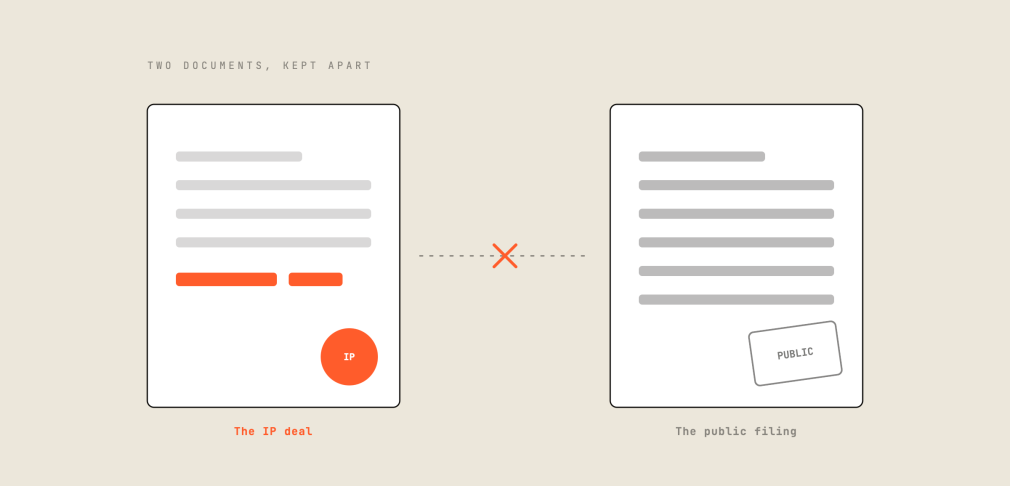
A practical solution is to use a two-document structure: (1) a confidential primary agreement containing the full transaction terms and (2) a short-form assignment used to record the ownership transfer.
This allows the buyer to establish a public chain of title without exposing sensitive terms such as the purchase price, indemnities, earnouts, or liability caps.
How it works
Assume Alpha Software LLC sells its software platform to Beta Technologies Inc.
The assets include:
- A registered trademark
- An issued patent
- A pending patent application
- Software source code
- Product documentation
The parties first sign a detailed Intellectual Property Purchase and Assignment Agreement.
That agreement may cover:
- The purchase price and payment schedule
- Representations about ownership
- Non-infringement warranties
- Indemnification obligations
- Liability limitations
- Transition services
- Confidentiality
- Any rights or licenses retained by the seller
The agreement also contains the language that legally transfers the intellectual property. Because it contains sensitive commercial information, the primary agreement remains private.
The short-form assignment
At closing, the seller also signs shorter assignment documents identifying the intellectual property being transferred.
These documents usually include:
- The name of the seller
- The name of the buyer
- Registration, patent, or application numbers
- The effective date
- A description of the rights transferred
- Signatures
They generally exclude the financial and risk-allocation terms of the broader transaction.
For example, a short-form patent assignment may state:
Alpha Software LLC assigns to Beta Technologies Inc. all right, title and interest in U.S. Patent No. 11,234,567 and U.S. Patent Application No. 18/123,456.
The buyer can record that document with the USPTO.
A trademark assignment may state:
Alpha Software LLC assigns to Beta Technologies Inc. all right, title and interest in the ALPHAFLOW trademark, together with the goodwill associated with the mark.
Including the associated goodwill is important because trademarks generally cannot be transferred separately from the business reputation and customer recognition they represent. A copyright assignment may identify the software source code, user manuals, or other protected works being transferred. It should clearly describe the relevant works and, where available, include copyright registration numbers.
What stays private?
The public record may show that Alpha transferred identified intellectual property to Beta.
It does not need to show:
- The purchase price
- Earnout terms
- Indemnification obligations
- Liability caps
- Source-code delivery arrangements
- Confidential product information
- Transition-service terms
Those provisions remain in the primary agreement.
Connecting the documents
The primary agreement should require the seller to deliver the short-form assignments at closing. It may also state that the short forms are intended only to facilitate recordation and that the primary agreement governs the parties’ broader commercial rights and obligations. However, the documents must be consistent. A short-form assignment should not accidentally transfer more or less than the parties agreed to in the main contract.
Common mistakes founders should avoid
Recording the entire agreement
This may unnecessarily expose pricing, warranties, commercial strategy, and confidential technical information.
Describing the IP too vaguely
The documents should identify the specific patents, applications, registrations, software versions, and copyrighted works being transferred.
Forgetting trademark goodwill
A trademark assignment that fails to transfer the associated goodwill may create ownership and enforceability problems.
Ignoring chain-of-title issues
Before selling IP, confirm that the company actually owns it. Founders should verify that employees, contractors, developers, and previous founders have properly assigned their rights to the company. Recording an assignment does not fix an earlier ownership defect.
The key takeaway
Founders do not have to choose between public recordation and commercial confidentiality. A well-structured transaction can use a detailed private agreement to govern the deal and short-form assignments to publicly document ownership. The result is a clearer chain of title without placing the economics and confidential terms of the transaction on the public record.
Disclaimer: This article is for general informational purposes and does not constitute legal advice.