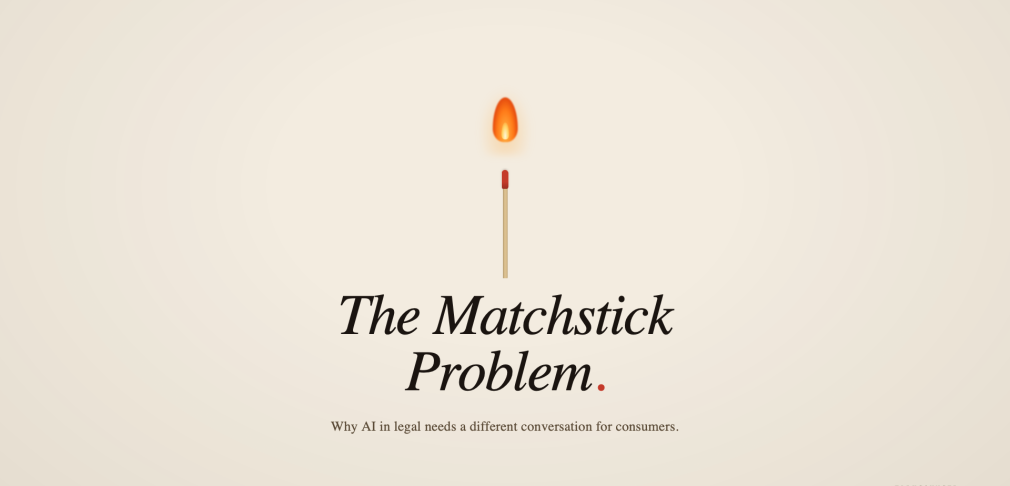
There is an old observation worth borrowing here: a matchstick can light up a house or burn one down. The difference is never the matchstick. It is always the hand holding it.
Artificial intelligence in legal services sits in exactly this tension right now. The tool itself is neither savior nor villain. But who is holding it, and what guardrails exist around that hand, make all the difference in the world.
Enterprise clients have quietly figured this out. When a Fortune 500 company or a well-funded startup deploys AI for legal work, it does not do so in a vacuum. There is usually a general counsel in the room, outside counsel on retainer, or, at a minimum, a legal operations team that understands what AI can and cannot be trusted to do alone. These organizations use AI to accelerate what their attorneys already know, drafting faster, reviewing contracts at scale, and flagging risk patterns across thousands of documents. The human with legal training is always in the loop. The AI is a lever, not a replacement. Risk is assessed before deployment. Outputs are reviewed before they become decisions. The matchstick is in trained hands.
The consumer experience is a fundamentally different story.
When an individual, a first-generation entrepreneur, a freelancer, a tenant facing eviction, a small business owner trying to protect something they built, turns to an AI tool for legal help, there is often no attorney standing behind them. There is no one to catch the hallucination buried in paragraph four of a generated lease agreement. There is no one to explain that the jurisdiction they are in interprets that clause differently, or that the statute the AI cited was amended two years ago, or that what reads like legal confidence is actually a confident guess.
The consumer does not know what they do not know. And AI, left unsupervised, does not know when to say so.
This is not an argument against AI in legal for consumers. Access to legal tools has always been stratified by wealth, and AI genuinely has the potential to close some of that gap. The problem is that the same tool being used responsibly inside a corporate legal department is being handed, often without context, without caveats, without a trained interpreter, to people who have no framework for evaluating whether the output is sound.
The enterprise client has a firewall. The consumer has a chat box.
What the legal industry has not yet done well is build the bridge between these two realities. Consumer-facing AI legal tools need to be designed with the assumption that users cannot audit the output, which means the tools themselves need to be more conservative, more transparent about uncertainty, and more insistent on when a real attorney must be involved. The phrase “This is informational, not legal advice,” buried at the bottom of a response, is not a guardrail. It is a disclaimer, and disclaimers do not protect people who do not know they need protecting.
There is also a question of responsibility for platforms offering AI-assisted legal access. The matchstick analogy holds here, too. A hardware store that sells matches to a trained electrician and to a curious child is technically doing the same thing in both transactions. But the outcomes are not equally foreseeable, and the accountability cannot be equally distributed.
The legal tech space is moving fast. Enterprise adoption is maturing. Consumer adoption is accelerating. The gap between those two realities, in sophistication, in oversight, in consequence, is where the most serious harm is likely to occur if the industry does not pause long enough to design for it intentionally.
AI can democratize legal access. But democratization without safeguards is not progress. It is exposure dressed up as empowerment.
The matchstick is neutral. The question has always been: who taught the person holding it what fire actually does?